Net-Soft deploys 25,000 smart water meters across three Tanzanian regions in milestone rollout.

Morem ipsum dolor sit amet, consectetur adipiscing elit. Etiam eu turpis molestie, dictum est a, mattis tellus. Sed dignissim, metus nec fringilla accumsan, risus sem sollicitudin lacus, ut interdum tellus elit sed risus. Maecenas eget condimentum velit, sit amet feugiat lectus. Class aptent taciti sociosqu ad litora torquent per conubia nostra, per inceptos himenaeos. Praesent auctor purus luctus enim egestas, ac scelerisque ante pulvinar. Donec ut rhoncus ex. Suspendisse ac rhoncus nisl, eu tempor urna. Curabitur vel bibendum lorem. Morbi convallis convallis diam sit amet lacinia. Aliquam in elementum tellus.
Why this matters
For utilities across the continent, metering is the single largest lever on operational sustainability. Without accurate, timely consumption data, a water authority is effectively running a subsidy programme — not a utility. Our Smart Water Meters solution was designed specifically for the pressure, dust, humidity and intermittent connectivity profiles that make East African deployments hard.
Inside the deployment
Every meter in the programme is a sealed, battery-backed NB-IoT unit with an expected ten-year field life. Readings are AES-256 encrypted on-device and transmitted through a dual-carrier network gateway before landing in the Net-Soft Meter Data Management layer, where they are reconciled against billing records and surfaced to utility operators via a role-based dashboard.
“We don’t just deploy devices. We deploy the operational muscle that lets a utility act on what the devices tell them — billing, leak response, customer service, procurement.”
— Eng. Fatma Mrisho, Project Director, Net-Soft Consult
Key technical choices
- Stainless-steel oval-gear measurement for abrasion resistance and ±0.5% accuracy across a 200:1 flow range.
- NB-IoT primary, 2G fallback so coverage gaps don’t become data gaps.
- On-device leak and reverse-flow detection — anomalies are flagged within one reporting cycle rather than waiting on downstream analytics.
- Prepaid and postpaid billing modes switchable per customer without a truck roll.

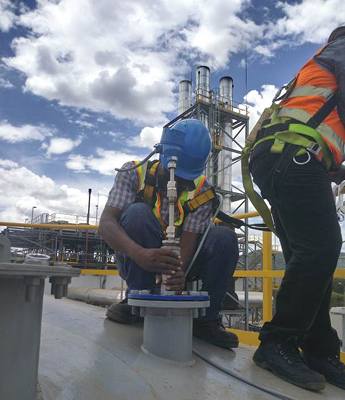
Net-Soft field technicians commissioning a DN20 residential meter in Msasani ward. Every installation is georeferenced against the utility’s customer cadaster before activation.
On-the-ground impact
In the first four pilot wards that went fully live in October 2025, the partner utility reported a 34% increase in billable volume within the first billing cycle — a direct consequence of replacing mechanical meters that had been under-registering by margins of up to 22%. Customer complaints on bill accuracy dropped sharply in parallel: households could now see their own consumption curves in the self-service portal and reconcile their bills against real numbers instead of monthly estimates.
The utility’s leak-response team has shifted from a reactive model — waiting for residents to call in burst pipes — to a proactive one, dispatching crews to night-flow anomalies the morning they appear. The effect compounds: every leak fixed before it becomes a main break is a week of service continuity preserved for an entire block of customers.
Building the same capability for your utility?
Our team can run a two-week technical feasibility assessment — covering network survey, hydraulic profile, existing billing integration, and deployment economics — before you commit to any hardware.