
Categories
Offline page
Net-Soft Consult Company (T) Ltd


All HTML headings, <h1> through <h6>, are available.
| Heading | Example |
|---|---|
|
|
h1. Bootstrap heading |
|
|
h2. Bootstrap heading |
|
|
h3. Bootstrap heading |
|
|
h4. Bootstrap heading |
|
|
h5. Bootstrap heading |
|
|
h6. Bootstrap heading |
.h1 through .h6 classes are also available, for when you want to match the font styling of a heading but cannot use the associated HTML element.
h1. Bootstrap heading
h2. Bootstrap heading
h3. Bootstrap heading
h4. Bootstrap heading
h5. Bootstrap heading
h6. Bootstrap heading
Use the included utility classes to recreate the small secondary heading text from Bootstrap 3.
Traditional heading elements are designed to work best in the meat of your page content. When you need a heading to stand out, consider using a display heading—a larger, slightly more opinionated heading style.
| Display 1 |
| Display 2 |
| Display 3 |
| Display 4 |
Make a paragraph stand out by adding .lead.
Vivamus sagittis lacus vel augue laoreet rutrum faucibus dolor auctor. Duis mollis, est non commodo luctus.
Styling for common inline HTML5 elements.
You can use the mark tag to highlight text.
This line of text is meant to be treated as deleted text.
This line of text is meant to be treated as no longer accurate.
This line of text is meant to be treated as an addition to the document.
This line of text will render as underlined
This line of text is meant to be treated as fine print.
This line rendered as bold text.
This line rendered as italicized text.
.mark and .small classes are also available to apply the same styles as <mark> and <small> while avoiding any unwanted semantic implications that the tags would bring.
While not shown above, feel free to use <b> and <i> in HTML5. <b> is meant to highlight words or phrases without conveying additional importance while <i> is mostly for voice, technical terms, etc.
Change text alignment, transform, style, weight, and color with our text utilities and color utilities.
Stylized implementation of HTML’s <abbr> element for abbreviations and acronyms to show the expanded version on hover. Abbreviations have a default underline and gain a help cursor to provide additional context on hover and to users of assistive technologies.
Add .initialism to an abbreviation for a slightly smaller font-size.
attr
HTML
For quoting blocks of content from another source within your document. Wrap <blockquote class="blockquote"> around any HTML as the quote.
Lorem ipsum dolor sit amet, consectetur adipiscing elit. Integer posuere erat a ante.
Add a <footer class="blockquote-footer"> for identifying the source. Wrap the name of the source work in <cite>.
Lorem ipsum dolor sit amet, consectetur adipiscing elit. Integer posuere erat a ante.
Use text utilities as needed to change the alignment of your blockquote.
Lorem ipsum dolor sit amet, consectetur adipiscing elit. Integer posuere erat a ante.
Lorem ipsum dolor sit amet, consectetur adipiscing elit. Integer posuere erat a ante.
Remove the default list-style and left margin on list items (immediate children only). This only applies to immediate children list items, meaning you will need to add the class for any nested lists as well.
Remove a list’s bullets and apply some light margin with a combination of two classes, .list-inline and .list-inline-item.
Align terms and descriptions horizontally by using our grid system’s predefined classes (or semantic mixins). For longer terms, you can optionally add a .text-truncate class to truncate the text with an ellipsis.
Vestibulum id ligula porta felis euismod semper eget lacinia odio sem nec elit.
Donec id elit non mi porta gravida at eget metus.
Responsive typography refers to scaling text and components by simply adjusting the root element’s font-size within a series of media queries. Bootstrap doesn’t do this for you, but it’s fairly easy to add if you need it.
Here’s an example of it in practice. Choose whatever font-sizes and media queries you wish.
Easily realign text to components with text alignment classes.
Ambitioni dedisse scripsisse iudicaretur. Cras mattis iudicium purus sit amet fermentum. Donec sed odio operae, eu vulputate felis rhoncus. Praeterea iter est quasdam res quas ex communi. At nos hinc posthac, sitientis piros Afros. Petierunt uti sibi concilium totius Galliae in diem certam indicere. Cras mattis iudicium purus sit amet fermentum.
For left, right, and center alignment, responsive classes are available that use the same viewport width breakpoints as the grid system.
Left aligned text on all viewport sizes.
Center aligned text on all viewport sizes.
Right aligned text on all viewport sizes.
Left aligned text on viewports sized SM (small) or wider.
Left aligned text on viewports sized MD (medium) or wider.
Left aligned text on viewports sized LG (large) or wider.
Left aligned text on viewports sized XL (extra-large) or wider.
Prevent text from wrapping with a .text-nowrap class.
For longer content, you can add a .text-truncate class to truncate the text with an ellipsis. Requires display: inline-block or display: block.
Praeterea iter est quasdam res quas ex communi.
Transform text in components with text capitalization classes.
Lowercased text.
Uppercased text.
CapiTaliZed text.
Note how text-capitalize only changes the first letter of each word, leaving the case of any other letters unaffected.
Quickly change the weight (boldness) of text or italicize text.
Bold text.
Normal weight text.
Light weight text.
Italic text.
.text-primary
.text-secondary
.text-success
.text-danger
.text-warning
.text-info
.text-light
.text-dark
.text-muted
.text-white
Contextual text classes also work well on anchors with the provided hover and focus states. Note that the .text-white and .text-muted class has no link styling.
Similar to the contextual text color classes, easily set the background of an element to any contextual class. Anchor components will darken on hover, just like the text classes. Background utilities do not set color, so in some cases you’ll want to use .text-* utilities.
Sometimes contextual classes cannot be applied due to the specificity of another selector. In some cases, a sufficient workaround is to wrap your element’s content in a <div> with the class.
Using color to add meaning only provides a visual indication, which will not be conveyed to users of assistive technologies – such as screen readers. Ensure that information denoted by the color is either obvious from the content itself (e.g. the visible text), or is included through alternative means, such as additional text hidden with the .sr-only class.
Ut convallis, sem sit amet interdum consectetuer, odio augue aliquam leo, nec dapibus tortor nibh sed augue. Integer eu magna sit amet metus fermentum posuere.
To explain what is a coworking space, let’s start by imagining a traditional office. As a company:
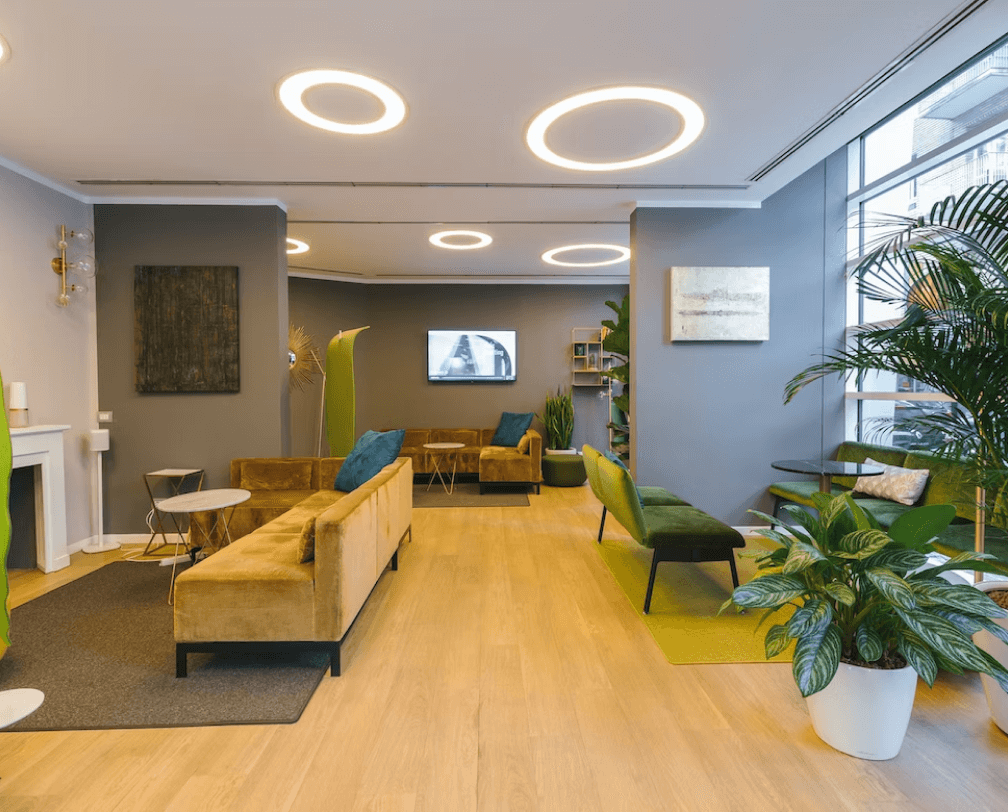
Now, imagine the opposite. Imagine a place where experts have put their years of experience in designing offices and their understanding of what employees want into a fantastic design. A design that’s created around collaboration, inspiration, and productivity. In a great coworking space, it doesn’t just stop with a better design. The entire interior and all furniture and equipment have already been paid for and installed. You can just walk in and get to work.
Then, especially in enterprise coworking, you have a team that operates the space for you. Anything that relates to the office, you can now just mention to the on-site team and they’ll arrange it for you. And what’s more, you only pay for the space you use. Often you can pay for only 15m2 for a small team, and get up to thousands of square meters of space and facilities to use whenever you want.
Now, imagine the opposite. Imagine a place where experts have put their years of experience in designing offices and their understanding of what employees want into a fantastic design. A design that’s created around collaboration, inspiration, and productivity. In a great coworking space, it doesn’t just stop with a better design. The entire interior and all furniture and equipment have already been paid for and installed. You can just walk in and get to work.
At coworking spaces, all of this work is done for you. A company can sign a membership agreement for as little as a few employees all the way up to hundreds of team members. That agreement can be short, or long, although most companies start off with a one year commitment. After all, you’re moving your team here, so you want them to not have to move again soon. From that moment on, anything that has to do with the office, is now the work of the coworking space. The company just needs to focus on their own business, and leave the management of the office to the coworking operator. Simply said, a coworking space allows companies to outsource all their office needs.
The main benefits of coworking space are flexibility, increased productivity, less work for the company, great IT, accommodating a Hybrid work or Work from Anywhere strategy, and a better employee experience.
Ut convallis, sem sit amet interdum consectetuer, odio augue aliquam leo, nec dapibus tortor nibh sed augue. Integer eu magna sit amet metus fermentum posuere.
To explain what is a coworking space, let’s start by imagining a traditional office. As a company:
Now, imagine the opposite. Imagine a place where experts have put their years of experience in designing offices and their understanding of what employees want into a fantastic design. A design that’s created around collaboration, inspiration, and productivity. In a great coworking space, it doesn’t just stop with a better design. The entire interior and all furniture and equipment have already been paid for and installed. You can just walk in and get to work.
Then, especially in enterprise coworking, you have a team that operates the space for you. Anything that relates to the office, you can now just mention to the on-site team and they’ll arrange it for you. And what’s more, you only pay for the space you use. Often you can pay for only 15m2 for a small team, and get up to thousands of square meters of space and facilities to use whenever you want.
Now, imagine the opposite. Imagine a place where experts have put their years of experience in designing offices and their understanding of what employees want into a fantastic design. A design that’s created around collaboration, inspiration, and productivity. In a great coworking space, it doesn’t just stop with a better design. The entire interior and all furniture and equipment have already been paid for and installed. You can just walk in and get to work.
At coworking spaces, all of this work is done for you. A company can sign a membership agreement for as little as a few employees all the way up to hundreds of team members. That agreement can be short, or long, although most companies start off with a one year commitment. After all, you’re moving your team here, so you want them to not have to move again soon. From that moment on, anything that has to do with the office, is now the work of the coworking space. The company just needs to focus on their own business, and leave the management of the office to the coworking operator. Simply said, a coworking space allows companies to outsource all their office needs.
The main benefits of coworking space are flexibility, increased productivity, less work for the company, great IT, accommodating a Hybrid work or Work from Anywhere strategy, and a better employee experience.
Ut convallis, sem sit amet interdum consectetuer, odio augue aliquam leo, nec dapibus tortor nibh sed augue. Integer eu magna sit amet metus fermentum posuere.
To explain what is a coworking space, let’s start by imagining a traditional office. As a company:
Now, imagine the opposite. Imagine a place where experts have put their years of experience in designing offices and their understanding of what employees want into a fantastic design. A design that’s created around collaboration, inspiration, and productivity. In a great coworking space, it doesn’t just stop with a better design. The entire interior and all furniture and equipment have already been paid for and installed. You can just walk in and get to work.
Then, especially in enterprise coworking, you have a team that operates the space for you. Anything that relates to the office, you can now just mention to the on-site team and they’ll arrange it for you. And what’s more, you only pay for the space you use. Often you can pay for only 15m2 for a small team, and get up to thousands of square meters of space and facilities to use whenever you want.
Now, imagine the opposite. Imagine a place where experts have put their years of experience in designing offices and their understanding of what employees want into a fantastic design. A design that’s created around collaboration, inspiration, and productivity. In a great coworking space, it doesn’t just stop with a better design. The entire interior and all furniture and equipment have already been paid for and installed. You can just walk in and get to work.
At coworking spaces, all of this work is done for you. A company can sign a membership agreement for as little as a few employees all the way up to hundreds of team members. That agreement can be short, or long, although most companies start off with a one year commitment. After all, you’re moving your team here, so you want them to not have to move again soon. From that moment on, anything that has to do with the office, is now the work of the coworking space. The company just needs to focus on their own business, and leave the management of the office to the coworking operator. Simply said, a coworking space allows companies to outsource all their office needs.
The main benefits of coworking space are flexibility, increased productivity, less work for the company, great IT, accommodating a Hybrid work or Work from Anywhere strategy, and a better employee experience.
Ut convallis, sem sit amet interdum consectetuer, odio augue aliquam leo, nec dapibus tortor nibh sed augue. Integer eu magna sit amet metus fermentum posuere.
To explain what is a coworking space, let’s start by imagining a traditional office. As a company:
Now, imagine the opposite. Imagine a place where experts have put their years of experience in designing offices and their understanding of what employees want into a fantastic design. A design that’s created around collaboration, inspiration, and productivity. In a great coworking space, it doesn’t just stop with a better design. The entire interior and all furniture and equipment have already been paid for and installed. You can just walk in and get to work.
Then, especially in enterprise coworking, you have a team that operates the space for you. Anything that relates to the office, you can now just mention to the on-site team and they’ll arrange it for you. And what’s more, you only pay for the space you use. Often you can pay for only 15m2 for a small team, and get up to thousands of square meters of space and facilities to use whenever you want.
Now, imagine the opposite. Imagine a place where experts have put their years of experience in designing offices and their understanding of what employees want into a fantastic design. A design that’s created around collaboration, inspiration, and productivity. In a great coworking space, it doesn’t just stop with a better design. The entire interior and all furniture and equipment have already been paid for and installed. You can just walk in and get to work.
At coworking spaces, all of this work is done for you. A company can sign a membership agreement for as little as a few employees all the way up to hundreds of team members. That agreement can be short, or long, although most companies start off with a one year commitment. After all, you’re moving your team here, so you want them to not have to move again soon. From that moment on, anything that has to do with the office, is now the work of the coworking space. The company just needs to focus on their own business, and leave the management of the office to the coworking operator. Simply said, a coworking space allows companies to outsource all their office needs.
The main benefits of coworking space are flexibility, increased productivity, less work for the company, great IT, accommodating a Hybrid work or Work from Anywhere strategy, and a better employee experience.
Ut convallis, sem sit amet interdum consectetuer, odio augue aliquam leo, nec dapibus tortor nibh sed augue. Integer eu magna sit amet metus fermentum posuere.
To explain what is a coworking space, let’s start by imagining a traditional office. As a company:
Now, imagine the opposite. Imagine a place where experts have put their years of experience in designing offices and their understanding of what employees want into a fantastic design. A design that’s created around collaboration, inspiration, and productivity. In a great coworking space, it doesn’t just stop with a better design. The entire interior and all furniture and equipment have already been paid for and installed. You can just walk in and get to work.
Then, especially in enterprise coworking, you have a team that operates the space for you. Anything that relates to the office, you can now just mention to the on-site team and they’ll arrange it for you. And what’s more, you only pay for the space you use. Often you can pay for only 15m2 for a small team, and get up to thousands of square meters of space and facilities to use whenever you want.
Now, imagine the opposite. Imagine a place where experts have put their years of experience in designing offices and their understanding of what employees want into a fantastic design. A design that’s created around collaboration, inspiration, and productivity. In a great coworking space, it doesn’t just stop with a better design. The entire interior and all furniture and equipment have already been paid for and installed. You can just walk in and get to work.
At coworking spaces, all of this work is done for you. A company can sign a membership agreement for as little as a few employees all the way up to hundreds of team members. That agreement can be short, or long, although most companies start off with a one year commitment. After all, you’re moving your team here, so you want them to not have to move again soon. From that moment on, anything that has to do with the office, is now the work of the coworking space. The company just needs to focus on their own business, and leave the management of the office to the coworking operator. Simply said, a coworking space allows companies to outsource all their office needs.
The main benefits of coworking space are flexibility, increased productivity, less work for the company, great IT, accommodating a Hybrid work or Work from Anywhere strategy, and a better employee experience.
Ut convallis, sem sit amet interdum consectetuer, odio augue aliquam leo, nec dapibus tortor nibh sed augue. Integer eu magna sit amet metus fermentum posuere.
To explain what is a coworking space, let’s start by imagining a traditional office. As a company:
Now, imagine the opposite. Imagine a place where experts have put their years of experience in designing offices and their understanding of what employees want into a fantastic design. A design that’s created around collaboration, inspiration, and productivity. In a great coworking space, it doesn’t just stop with a better design. The entire interior and all furniture and equipment have already been paid for and installed. You can just walk in and get to work.
Then, especially in enterprise coworking, you have a team that operates the space for you. Anything that relates to the office, you can now just mention to the on-site team and they’ll arrange it for you. And what’s more, you only pay for the space you use. Often you can pay for only 15m2 for a small team, and get up to thousands of square meters of space and facilities to use whenever you want.
Now, imagine the opposite. Imagine a place where experts have put their years of experience in designing offices and their understanding of what employees want into a fantastic design. A design that’s created around collaboration, inspiration, and productivity. In a great coworking space, it doesn’t just stop with a better design. The entire interior and all furniture and equipment have already been paid for and installed. You can just walk in and get to work.
At coworking spaces, all of this work is done for you. A company can sign a membership agreement for as little as a few employees all the way up to hundreds of team members. That agreement can be short, or long, although most companies start off with a one year commitment. After all, you’re moving your team here, so you want them to not have to move again soon. From that moment on, anything that has to do with the office, is now the work of the coworking space. The company just needs to focus on their own business, and leave the management of the office to the coworking operator. Simply said, a coworking space allows companies to outsource all their office needs.
The main benefits of coworking space are flexibility, increased productivity, less work for the company, great IT, accommodating a Hybrid work or Work from Anywhere strategy, and a better employee experience.
Ut convallis, sem sit amet interdum consectetuer, odio augue aliquam leo, nec dapibus tortor nibh sed augue. Integer eu magna sit amet metus fermentum posuere.
To explain what is a coworking space, let’s start by imagining a traditional office. As a company:
Now, imagine the opposite. Imagine a place where experts have put their years of experience in designing offices and their understanding of what employees want into a fantastic design. A design that’s created around collaboration, inspiration, and productivity. In a great coworking space, it doesn’t just stop with a better design. The entire interior and all furniture and equipment have already been paid for and installed. You can just walk in and get to work.
Then, especially in enterprise coworking, you have a team that operates the space for you. Anything that relates to the office, you can now just mention to the on-site team and they’ll arrange it for you. And what’s more, you only pay for the space you use. Often you can pay for only 15m2 for a small team, and get up to thousands of square meters of space and facilities to use whenever you want.
Now, imagine the opposite. Imagine a place where experts have put their years of experience in designing offices and their understanding of what employees want into a fantastic design. A design that’s created around collaboration, inspiration, and productivity. In a great coworking space, it doesn’t just stop with a better design. The entire interior and all furniture and equipment have already been paid for and installed. You can just walk in and get to work.
At coworking spaces, all of this work is done for you. A company can sign a membership agreement for as little as a few employees all the way up to hundreds of team members. That agreement can be short, or long, although most companies start off with a one year commitment. After all, you’re moving your team here, so you want them to not have to move again soon. From that moment on, anything that has to do with the office, is now the work of the coworking space. The company just needs to focus on their own business, and leave the management of the office to the coworking operator. Simply said, a coworking space allows companies to outsource all their office needs.
The main benefits of coworking space are flexibility, increased productivity, less work for the company, great IT, accommodating a Hybrid work or Work from Anywhere strategy, and a better employee experience.